
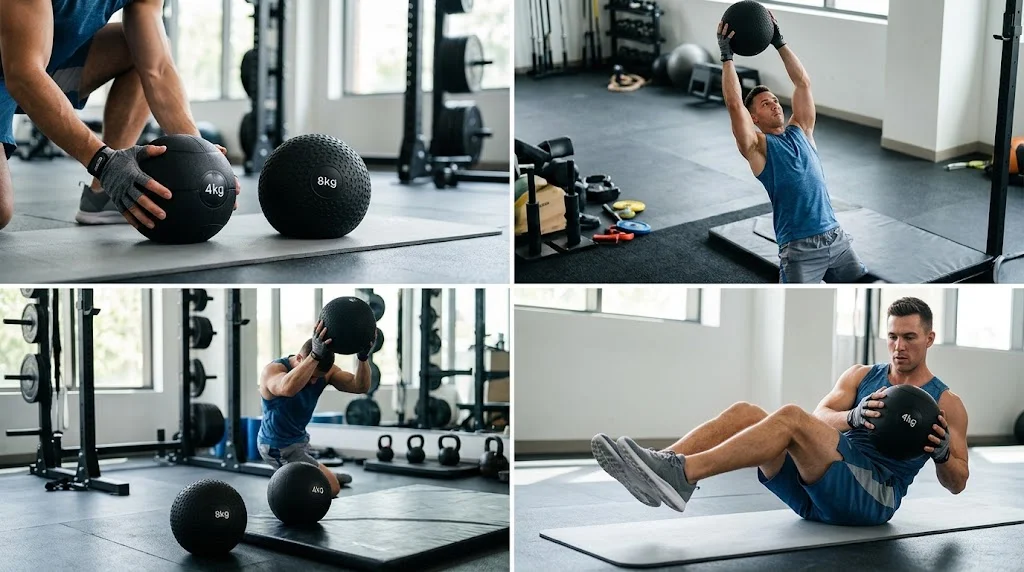
Modern strength training often leaves athletes trapped in single directions. Traditional barbells and weight machines lock your body into rigid tracks, forcing you to move exclusively forward and backward or straight up and down. While lifting heavy iron is fantastic for raw force output, everyday life and athletic sports demand speed, rotational torque, and the ability to absorb impact seamlessly. A structured medicine ball routine bridges this gap. By allowing you to accelerate through an entire movement without artificially slowing down at the end range, weighted sphere training develops real explosive power.
Whether your goal is to build dense core stability, improve rotational speed for sports, or torch calories with a fast conditioning circuit, this comprehensive guide delivers a balanced training plan designed for results.
Quick Routine Overview
Before diving into the mechanics, here is a snapshot of what to expect from this full-body session:
-
Total Duration: 20 to 25 minutes
-
Training Format: High-intensity interval circuit
-
Equipment Needed: One medicine ball or slam ball (3 kg to 8 kg based on strength level)
-
Target Outcomes: Explosive triple extension, multi-planar core stability, cardiovascular endurance, and total-body muscular tone
Slam Ball vs. Medicine Ball: The Critical Equipment Distinction
Before grabbing the first ball on the gym rack, you must know what tool you are holding. Many lifters use the terms interchangeably, but doing so can lead to painful accidents.
A traditional rubber medicine ball features a firm outer shell that bounces aggressively off hard surfaces. These tools are engineered for wall throws, partner chest passes, and reactive rebound drills. If you forcefully throw a hard-shell rubber ball straight down into the floor, it can rebound straight into your face.

A dead-bounce slam ball is filled with shifting sand and encased in a thick, pliable vinyl skin. When thrown into the ground, it hits with a heavy thud and stays put, forcing you to bend down and retrieve it.
If your session calls for overhead floor slams, always reach for a dead-bounce sand ball. If your workout features wall balls, rebound chest passes, or controlled rotational twists, a classic rubber or leather-bound medicine ball is the correct choice.
How to Select the medicine ball routine Weight
A common mistake with medicine ball training is treating the ball like a heavy barbell. The true value of a weighted ball lies in movement velocity and kinetic transfer, not maximal load. If the weight is too heavy, your movement slows to a crawl, your form breaks down, and the explosive training stimulus vanishes.
-
For Explosive Power and Rotational Speed: Choose a light ball between 4 and 8 pounds (2 kg to 4 kg). You should be able to move the ball with rapid acceleration while maintaining a rigid spine.
-
For Compound Strength and Core Resistance: Choose a medium ball between 10 and 20 pounds (5 kg to 9 kg). This weight range suits movements like squats, lunges, and controlled trunk rotations.
Use the 10-rep test to verify your selection. Pick a weight and perform ten continuous, crisp repetitions of an exercise. You should feel genuine muscular fatigue around rep eight or nine, but your spinal alignment, balance, and speed should remain completely intact. If your shoulders round forward or your lower back arches to compensate, swap the ball for a lighter option immediately.
Dynamic Warm-Up and Movement Prep
Never jump into dynamic throws with cold joints. Spend five minutes prepping your spine, shoulders, and hips with these three targeted activation drills:

-
Medicine Ball Chest Hug with Thoracic Extension: Stand tall while holding the ball against your sternum with both arms. Inhale deeply, pull your shoulders down and back, and gently arch your upper back backward over a five-second count. Exhale and return to neutral. Complete 8 smooth repetitions to open up the thoracic spine.
-
Half-Kneeling Halo Rotations: Drop into a half-kneeling lunge position on a mat. Hold a light ball at chest height and slowly circle it around your head in a tight halo pattern, keeping your ribcage locked down and hips completely square. Perform 5 rotations clockwise and 5 counter-clockwise on each leg.
-
Light Reactive Bounce Catches: Stand facing a concrete wall about three feet away. Using a light rubber ball, perform quick, chest-level bounce passes against the wall, catching and returning the ball as quickly as possible for 30 seconds to wake up your central nervous system.
The Full-Body Medicine Ball Routine: Step-by-Step Circuit
Perform this workout as a continuous circuit. Move through each exercise using the designated work-to-rest ratios outlined in the training protocol below.
Movement 1: Overhead medicine ball routine
The overhead slam develops explosive hip extension, lat engagement, and anterior core power without placing jarring stress on your lower joints.
-
Primary Targets: Latissimus dorsi, abdominals, shoulders, glutes, and hamstrings
-
Setup: Stand with your feet shoulder-width apart, holding a dead-bounce ball with both hands at chest level.
-
Execution: Inhale as you rise up onto the balls of your feet, extending your ankles, knees, and hips while bringing the ball directly overhead. Without pausing at the top, hinge aggressively at your hips, brace your abdominals, and throw the ball downward into the floor with maximum force. Follow through with your arms, catch the ball on the slight hop or scoop it off the floor, and immediately transition into the next repetition.
-
Pro Tip: Do not simply bend your waist and drop the ball. Actively pull the ball down using your lats and core muscles as if you are slamming a door shut.
Movement 2: Squat to Overhead Thruster
This multi-joint compound movement combines a deep lower-body squat with an explosive overhead press, elevating your heart rate while challenging the entire kinetic chain.
-
Primary Targets: Quadriceps, glutes, anterior deltoids, triceps, and upper back
-
Setup: Stand tall with your feet slightly wider than hip-width apart and toes angled out ten degrees. Hold the medicine ball securely at chest level, keeping your elbows tucked tightly against your ribs.
-
Execution: Inhale and initiate the squat by pushing your hips back and bending your knees. Lower down until your thighs are parallel to the floor, keeping your chest proud and spine neutral. Drive hard through your heels to return to standing. As you approach the top of the squat, transfer that upward momentum directly into your upper body, pressing the ball smoothly overhead until your arms are fully extended alongside your ears. Lower the ball back to your chest as you descend into the next squat.
-
Pro Tip: Avoid letting the weight of the ball pull your torso forward during the bottom of the squat. Keep your eyes forward and core braced.
Movement 3: Rotational Woodchop
Most strength routines completely ignore the transverse plane of motion. The rotational woodchop builds athletic rotational power through the hips while teaching your core how to transmit force diagonally.

-
Primary Targets: Internal and external obliques, transverse abdominis, shoulders, and glutes
-
Setup: Stand with your feet wider than shoulder-width apart. Hold the ball with both hands down near the outside of your right hip, shifting your weight onto your right leg while pivoting slightly on your left foot.
-
Execution: In an explosive, diagonal motion, sweep the ball up and across your torso, driving power from your right hip and pivoting your back foot. Finish with the ball extended high above your left shoulder. Control the descent as you guide the ball back along the same diagonal path to your right hip. Complete all designated repetitions on one side before switching to the opposite direction.
-
Pro Tip: Power comes from the hip pivot, not the arms. Think of your arms merely as cables connecting the weight to your hips and torso.
Movement 4: Offset Push-Up to Ball Roll
This variation adds an asymmetric stability challenge to the classic push-up, demanding deep rotator cuff engagement and anti-rotational core strength.
-
Primary Targets: Pectorals, anterior deltoids, triceps, and deep abdominal wall
-
Setup: Assume a standard high plank position with your hands beneath your shoulders. Place your right hand firmly on top of the medicine ball and your left hand flat on the floor.
-
Execution: Inhale and lower your chest toward the floor, keeping your elbows at a 45-degree angle relative to your torso. Maintain a straight line from your head to your heels without letting your hips sag or tilt to one side. Exhale and press forcefully back up to full extension. Once at the top, smoothly roll the ball across the floor to your left hand, place your right hand on the floor, and repeat the movement on the opposite side.
-
Pro Tip: If your hips twist during the roll, widen your foot stance to create a broader, more stable foundation.
Movement 5: Elevated Russian Twist
The Russian twist strengthens the rotational fibers of your abdominal wall while building isometric endurance through the hip flexors and lower back.
-
Primary Targets: Obliques, rectus abdominis, and hip flexors
-
Setup: Sit on an exercise mat with your knees bent and your heels resting lightly on the ground. Hold the medicine ball at your chest. Lean your torso backward to a 45-degree angle, feeling your abdominal muscles engage to support your spine.
-
Execution: For an advanced challenge, lift your heels two to three inches off the floor to balance on your sit bones. While keeping your lower body still, rotate your torso from the ribcage to the right, bringing the ball toward the floor just beside your right hip. Pause briefly, then twist your torso across center to touch the ball near your left hip. Continue alternating sides with deliberate control.
-
Pro Tip: Do not simply wave your arms from side to side. Your sternum and shoulders must turn along with the ball on every single repetition.
Training Protocols: Choose Your Intensity Level
How you sequence these movements determines your physiological adaptations. Select the protocol that best matches your current conditioning level:
Beginner Protocol
-
Work-to-Rest Ratio: 30 seconds of work followed by 30 seconds of rest
-
Total Rounds: 3 rounds through the 5-exercise circuit
-
Rest Between Rounds: 90 seconds
-
Focus: Mastering movement mechanics and maintaining crisp spinal alignment
Intermediate and Advanced Protocol
-
Work-to-Rest Ratio: 45 seconds of work followed by 15 seconds of rest
-
Total Rounds: 4 rounds through the 5-exercise circuit
-
Rest Between Rounds: 60 seconds
-
Focus: Maximizing movement velocity, cardiovascular density, and muscular endurance
How to Progress Without Buying a Heavier Ball
When bodyweight training feels too easy, people add weight plates. With medicine ball training, purchasing a heavier ball is not always the best answer. Moving a ball that is too heavy ruins the speed benefits that make this training style unique. Instead, use these three progression strategies to make this medicine ball routine significantly more demanding with your existing gear:
-
Accelerate the Concentric Phase: Instead of moving at a steady tempo, attempt to move the ball with violent speed during the driving phase of the movement. Intentionally generating more speed forces your motor units to recruit more muscle fibers instantly.
-
Lengthen the Lever Arm: The further the ball sits from your center of mass, the heavier it feels to your core. During twists or squats, hold the ball several inches further away from your chest. That minor positional adjustment dramatically increases the rotational torque required from your core muscles.
-
Reduce Your Base of Support: Transition bilateral movements into staggered or single-leg stances. Performing rotational chops from a half-kneeling position or executing squats in a narrow stance forces your stabilizer muscles to work overtime to prevent falling off balance.
Recovery and Weekly Programming
Because medicine ball training places unique demands on the central nervous system and connective tissues through deceleration forces, smart scheduling is essential.
You can safely perform a medicine ball routine two to three times per week on non-consecutive days. This schedule allows 48 hours between workouts for muscular recovery and nervous system reset.
This style of workout pairs exceptionally well with traditional strength programs. You can run this routine as a standalone 20-minute metabolic conditioning session on your cardio days, or cherry-pick two specific movements, such as the overhead slam and rotational woodchop, to serve as an explosive neural primer before a heavy barbell lifting session.
FAQs
Can you get a full-body workout using only a medicine ball?
Yes. A medicine ball allows you to train every fundamental human movement pattern, including squats, hinges, pushes, pulls, and rotations. Because the weight can be moved across multiple planes of motion at varying speeds, it challenges your muscular strength, joint stability, and cardiovascular endurance simultaneously.
Is a medicine ball better than dumbbells for burning fat?
Neither tool is universally better, but they serve different functions. Dumbbells excel at providing continuous eccentric tension for muscle hypertrophy, while medicine balls allow for unrestricted acceleration, throwing, and rapid full-body movements.
Can you do medicine ball routine training every single day?
Training at maximum power output every single day is not recommended. Explosive throws, slams, and dynamic rotations place substantial stress on your central nervous system, shoulders, and spine. To avoid overtraining and maintain optimal movement speed, schedule your training two to three times per week with adequate rest days in between.
