
The deadlift remains one of the most productive compound movements in strength training. However, it frequently causes severe lower back discomfort for many dedicated athletes. Consequently, when entering a modern fitness facility, you will likely encounter an angular, diamond-shaped piece of equipment designed to solve this exact problem. Commonly known as the hex bar, the trapezius bar was engineered to address the mechanical flaws of pulling heavy iron directly from the floor. By placing the lifter inside the frame rather than behind a straight bar, it turns a punishing pull into an ergonomic, joint-friendly exercise.
Therefore, whether your priority is building thicker upper traps, enhancing vertical power for competitive athletics, or training hard without lingering spinal aches, this specialized tool deserves your attention. Below is your comprehensive guide to understanding, executing, and selecting this essential barbell variation for optimal performance.
1. What is a Trapezius Bar? Design, Origins, and Equipment Anatomy
The Origins and Vision of Al Gerard
The historical origins of this implement trace back to competitive powerlifter Al Gerard during the 1980s. Gerard suffered from recurring lower back injuries that severely compromised his ability to pull conventional straight barbells safely. As a result, he sought a reliable method to load his hips and legs while protecting his spine. He ultimately fabricated a hexagonal frame that permitted the user to stand directly inside the center of mass. Soon after, he dubbed it after the primary muscle group it heavily stimulated during upright pulling movements: the trapezius bar.
Frame Anatomy and Weight Specifications
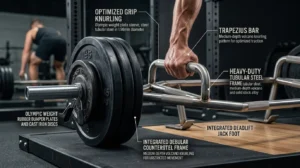
Mechanically, a standard closed hex frame consists of heavy-duty welded steel tubing arranged in a symmetrical diamond or hexagon. Two parallel side handles provide lifters with a natural neutral grip where their palms face each other comfortably. In addition, high-grade versions feature Olympic-sized sleeves measuring 1.96 inches in diameter, ensuring complete compatibility with standard bumper plates and cast iron discs. While a standard straight barbell weighs exactly 45 pounds, a trapezius bar can range between 45 and 65 pounds depending on tubing gauge, knurling depth, and structural frame dimensions.
Furthermore, it is worth establishing an essential distinction for online searchers. A lifting hex frame is entirely separate from a medical trapeze bed bar, which is an overhead patient-assist bar mounted to hospital beds. For strength, athletic conditioning, and muscle building, our sole focus is on the heavy-duty hexagonal barbell.
2. The Biomechanics: How the Hex Frame Relieves Lumbar Stress
Eliminating the Anterior Moment Arm
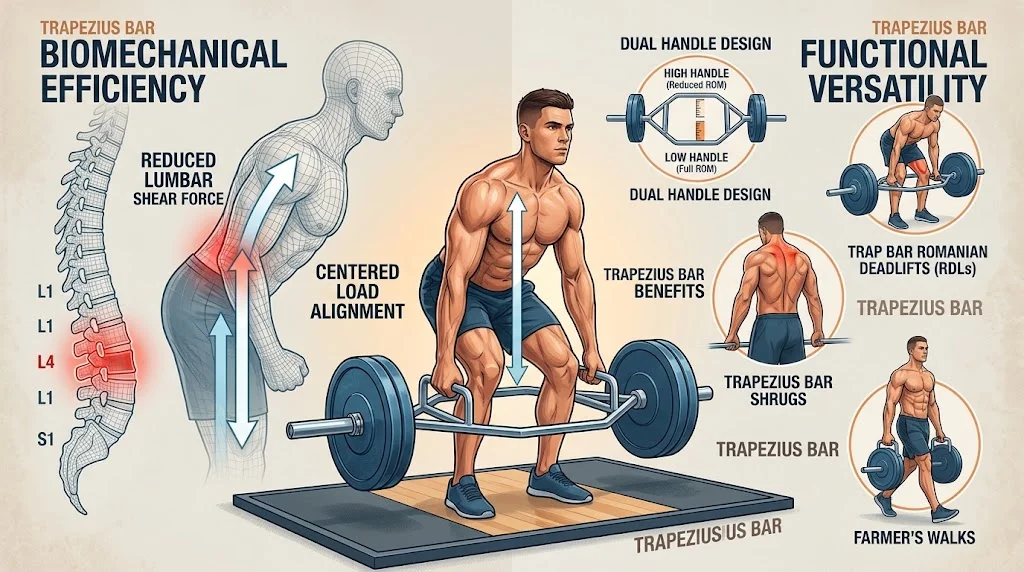
To understand why this tool functions so effectively, consider the physics of a conventional straight bar. In a standard deadlift, the bar remains entirely in front of the body, traveling along the shins and past the knees. Consequently, this physical separation creates a substantial anterior moment arm, which is the horizontal distance between the load and the lumbar spine. That horizontal gap acts as an intense lever against your lower back, creating massive spinal shear force during every repetition.
Stepping inside a trapezius bar eliminates that problematic lever arm. Because the weight stays perfectly aligned with your ankles and midfoot throughout the movement, the resistance moves naturally along your true center of mass.
Distributing Load Across the Kinetic Chain
Because the load shifts directly inward, shear forces acting against the L4-L5 vertebrae decrease dramatically. Simultaneously, your torso remains in a much more upright position throughout the pull. Therefore, this mechanical adjustment transfers excessive strain away from the lower spinal erectors and evenly distributes the workload across the quadriceps, gluteus maximus, and hamstrings.
Additionally, pulling from your sides removes the dangerous asymmetrical torso twist that frequently occurs when using a mixed grip on a conventional barbell. As a direct result, it eliminates the frightening risk of distal biceps tendon tears associated with heavy underhand pulling.
3. High Handles vs. Low Handles: Tailoring Range of Motion
One notable feature of the dual-handle frame is the ability to quickly flip the bar over. Choosing between high and low handles is not a matter of taking an easy shortcut; rather, it is an intelligent biomechanical adjustment based on individual body proportions and personal training intent.
High Handle Mechanics and Mobility Benefits
The elevated handles sit roughly 3 to 4 inches higher than the central axle. Consequently, this configuration shortens the total range of motion, requiring significantly less hip and ankle flexion to grip the bar securely. For this reason, it serves as an ideal setup for:
-
Lifters working through ankle mobility restrictions or tight hip capsules.
-
Taller athletes with long femurs who struggle to reach floor level without rounding their spine.
-
Overload training blocks, where the primary objective is lifting maximum weight to build pure neural output and lockout confidence.

Low Handle Mechanics for Maximum Range
Conversely, flipping the bar over to utilize handles that sit flush with the sleeves requires you to pull from standard barbell height. Specifically, this starting position places the grips roughly 8.8 inches from the floor when using standard Olympic plates. Therefore, this low-handle configuration:
-
Demands a full, uncompromised range of motion through the knees and hips.
-
Increases knee flexion at the start, thereby generating far greater quadriceps recruitment off the floor.
-
Encourages direct, functional carryover to conventional pulls for competitive strength athletes.
4. Muscle Activation Profile: Primary Movers and Stabilizers
A common misunderstanding among lifters is that this tool isolates only the upper back due to its unique name. In reality, stepping into a trapezius bar delivers a potent, synchronized full-body stimulus, distributing intense muscular work among several major functional groups.
Lower Body Movers
-
Quadriceps: Because of the increased knee flexion required at the bottom of the pull, the quadriceps work far harder than in a standard barbell deadlift, powerfully initiating the first third of the movement.
-
Gluteus Maximus and Hamstrings: Subsequently, as the bar rises past mid-shin height, forceful hip extension drives the lockout, compelling the glutes into deep peak contraction without hyperextending your spine.
Upper Body and Core Stabilizers
-
Trapezius and Upper Back: Holding substantial loads with your arms hanging straight at your sides forces the upper, middle, and lower trapezius to contract isometrically to prevent shoulder depression.
-
Latissimus Dorsi: Similarly, engaging the lats prevents the frame from tilting forward or backward, turning the upper torso into a rigid, protective cylinder.
-
Forearms and Grip: The neutral hand position naturally allows for greater crushing grip strength than double-overhand straight bar work, stimulating deep muscle development across the forearms.

5. Execution Guide: Perfecting the Deadlift Technique
Proper lifting technique ensures that you harvest maximum muscle recruitment while remaining safe. Therefore, follow this systematic step-by-step checklist for consistent, repeatable execution on every set.
Stance and Initial Setup
First, step into the center of the frame and place your feet hip-width to shoulder-width apart. Next, point your toes straight ahead or slightly outward by five to ten degrees. Then, look down to verify that the center of each handle aligns directly across the middle of your shoelaces.
The Hip Hinge and Grip
After setting your feet, push your hips backward as if aiming to touch a distant wall behind you. Soften your knees and let your shins angle forward slightly until your hands reach the handles. Immediately grasp the exact center of each grip, because an off-center hold will cause the bar to tilt awkwardly.
Torso Bracing and Lat Tension
Next, pull your chest up proudly, draw your shoulder blades down toward your back pockets, and engage your lats. Take a deep diaphragmatic breath into your belly and brace your abdominal wall firmly. Meanwhile, keep your cervical spine neutral by focusing your eyes on the floor four to five feet ahead.
The Concentric Drive
Drive your feet through the floor by pushing through your midfoot and heels. Rather than actively pulling the bar with your arms, imagine leg-pressing the floor downward. As the bar glides past your knees, squeeze your glutes hard and push your hips forward to stand completely erect without leaning backward.
The Eccentric Return
Finally, hinge backward at the hips under full control, lowering the plates smoothly to the floor. Let the weight settle to a dead stop, reset your air, verify your alignment, and begin your next repetition.
6. Ten High-Yield Exercises Beyond the Standard Deadlift
The practical utility of this specialized frame extends far beyond simple floor pulls. Specifically, here are versatile movements that exploit its unique geometry to build strength, endurance, and athleticism.
Upper Body and Posterior Chain Builders
-
Heavy Shrugs: First, stand upright with the frame held firmly at your sides. Keeping your arms extended, elevate your shoulders directly toward your ears and pause for a deliberate second to isolate the upper fibers.
-
Farmer’s Walks: Pick up a heavy load, stand tall, and walk forward with short, measured strides for 40 to 60 feet. Consequently, this challenges grip endurance, upper-back thickness, and lateral core stability.
-
Romanian Deadlifts (RDLs): Unlock your knees slightly and keep them fixed. Then, hinge backward at your hips to load your hamstrings and glutes through an intense, isolated muscular stretch.
-
Bent-Over Rows: Hinge forward to a 45-degree angle, establish a flat back, and row the handles toward your hips. As a result, the neutral grip reduces wrist strain while maximizing lat recruitment.
-
Floor Press: Lie flat on your back inside the bar on the gym floor. Grip the handles and press upward. Because the floor limits excessive elbow drop, it provides heavy triceps overload without irritating your shoulders.
Unilateral, Explosive, and Core Variations
-
Elevated Split Squats: Stand inside an open or wide frame, place your rear foot on a bench, and squat down. The centered handle position keeps your balance far steadier than handheld dumbbells.
-
Jump Squats: Using light resistance (around 15 to 20 percent of your max), drop into a shallow squat and jump upward explosively to build dynamic triple-extension power.
-
Inverted Rows: Rest the bar securely on the safety pins of a power rack at waist height. Hang underneath the frame with heels planted, and row your sternum upward toward the handles.
-
Suitcase Carries: Pick up an open-frame bar with only one hand on the side and walk forward. This forces your obliques and deep spinal stabilizers to fight asymmetrical tipping forces.
-
Tall-Kneeling Overhead Press: Kneel with both knees on a soft pad and press the bar directly overhead. Because this kneeling posture completely eliminates leg drive, it forces strict upper-body pressing strength and core control.
7. Comparative Analysis: Trapezius Bar vs. Traditional Straight Barbell
When deciding which specialty implement belongs in your training plan, examining their physical qualities highlights where each excels.
| Feature / Dynamic | Trapezius Bar | Traditional Straight Barbell |
| Grip Orientation | Neutral (palms facing inward) | Pronated, supinated, or mixed |
| Center of Gravity | Aligned with the body’s midline | Positioned 4 to 8 inches in front of shins |
| Lumbar Shear Load | Significantly lower | Moderate to high |
| Quadriceps Activation | Substantially higher | Moderate |
| Hamstring Isolation | Moderate (spread across thighs) | High (dominant hip-hinge focus) |
| Maximal Load Potential | 5 to 10 percent higher for most lifters | Standard reference benchmark |
| Learning Curve | Gentle; intuitive for beginners | Steep; requires extensive technical coaching |
| Powerlifting Legality | Prohibited in sanctioned competition | Universally required |
Understanding Competitive Rules
Lifting with a trapezius bar allows most athletes to lift five to ten percent more weight than they can on a straight bar due to mechanical efficiency and quad recruitment. Consequently, competitive powerlifting federations like the IPF and USAPL do not permit it in official meets. For powerlifters, the straight bar remains mandatory. However, for non-competitive lifters, field-sport athletes, and home fitness fans, the hex design provides superior training volume with lower fatigue.
8. Open vs. Closed Frame: The Modern Equipment Evolution
Modern equipment manufacturers have shifted how these specialty bars are fabricated, introducing versatile open-ended variants alongside classic closed shapes.
Traditional Closed Hexagonal Design
This classic layout encloses the lifter entirely within four to six welded structural steel tubes.
-
Notable Advantages: It is exceptionally rigid, naturally well-balanced, symmetrical, and considerably more affordable for budget-conscious buyers.
-
Practical Limitations: However, you must step into and out of the center carefully. Furthermore, the front and rear crossbars severely restrict forward stride length, completely ruling out natural walking lunges or aggressive carry work.
Modern Open-Ended Frames
Conversely, the open design removes one side of the frame, relying on an engineered counterbalance system or heavy structural steel arch.
-
Notable Advantages: It permits completely unrestricted forward movement. Therefore, you can easily perform walking lunges, broad step-ups, and long-distance farmer’s carries without striking your shins. In addition, many open models feature integrated deadlift jacks, allowing you to tip the frame upright to change weight plates effortlessly.
-
Practical Limitations: Nevertheless, these advanced designs come with higher manufacturing costs and elevated price tags. Furthermore, if loaded carelessly or unevenly, the frame can tilt along its central axis during initial setup.
9. Equipment Buyer’s Checklist for Home and Commercial Gyms
Selecting the right bar requires careful evaluation of essential build specifications. Therefore, keep this checklist in mind before making an investment.
Sleeve Dimensions and Steel Quality
First, always confirm that the bar features standard 1.96-inch Olympic sleeves. Additionally, look for a loadable sleeve length of at least 12 to 16 inches, because shorter sleeves will drastically limit how many wide bumper plates you can load. Similarly, ensure that the frame is constructed from durable 11-gauge tubular steel or solid solid-stock alloy with a verified weight rating of at least 700 to 1,000 pounds.
Knurling Quality and Power Rack Fit
Next, pay close attention to the handle texture. Look for clean, medium-depth volcano knurling that provides dependable traction without tearing your hands during high-volume sets. Finally, check whether the bar’s exterior width allows it to rest securely on standard 47-inch or 49-inch power rack J-hooks. A rackable frame makes loading plates, resetting between sets, and executing overhead presses vastly simpler.
10. Frequently Asked Questions
Is using a hex bar considered cheating compared to a regular deadlift?
No, it is certainly not cheating. While you can typically lift slightly heavier weights because the load aligns with your center of mass, it is simply a different movement pattern. Specifically, it demands more leg drive and less lower-back strain, making it an efficient strength-builder rather than an artificial shortcut.
Can I build big traps without doing separate shrugs?
Holding heavy loads during floor pulls creates intense isometric loading through your upper back and shoulders. That said, pairing heavy deadlifts with dedicated, paused shrugs using the neutral handles remains the fastest path to expanding trapezius thickness.
What should I do if my home gym has limited space?
If floor space is tight, look for an open-ended frame featuring an integrated upright kickstand. Consequently, this allows you to store the implement vertically against a corner wall, taking up only a compact two-foot square footprint.
Ultimately, mastering this versatile bar allows you to chase personal records, build broad shoulders, and push your leg development without exposing your lower back to excessive stress in the trapezius bar. Therefore, make it a central component of your strength training to unlock sustainable, long-term power.
